

Key Takeaways
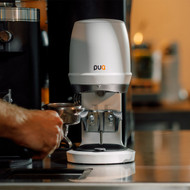
- The best espresso tamper for a high-volume cafe is automatic: At 50 or more drinks per hour, the PUQpress Q Gen 6 typically pays for itself in 6 to 9 months through reduced shot waste, faster service, and lower barista injury risk.
- Espresso tamper sizing is not interchangeable: Match your tamper diameter to your portafilter basket within 0.1mm. A 58mm tamper in a 58.4mm basket loses 12 to 15% of contact area, which means channeling and wasted shots.
- A commercial espresso tamper doesn't have to be automatic: Sub-30 drinks per hour single-barista setups don't need automation. A solid Revolution wood-handle espresso tamper at the right size delivers consistent results without the $900-to-$1,700 capital outlay of a PUQpress.
Choosing the right espresso tamper for a cafe comes down to volume, staff, and culture. For most commercial cafes doing 50 or more drinks per hour, the PUQpress Q Gen 6 delivers the best balance of consistency, footprint, and payback period — typically 6 to 9 months versus a fully manual setup. For artisan single-barista shops or low-volume operations under 30 drinks per hour, a properly sized Revolution wood-handle tamper at 58.3mm or 58.4mm is the smarter spend. The rest of this guide unpacks the why, the sizing math, and the three scenarios where each choice actually pays off. The short version: match the tool to your actual volume, not your aspirations.
Why Tamper Choice Matters in a Commercial Setting
The tamp is the single most variable step in espresso preparation. Every other variable — grind setting, dose weight, water temperature, pressure profile — gets controlled by the machine and the grinder. The tamp depends on whoever pulled the last shot. In a single-barista shop with a thirty-year veteran behind the bar, that variability is tiny. In a six-barista rotation across two shifts, it's the difference between consistent shots and a sink full of dumped doubles.
Here's what an inconsistent tamp actually does to the cup. When pressure isn't even across the puck, water finds the path of least resistance and channels through. The shot tastes thin and under-extracted on one side, bitter and over-extracted on the other. You get an average that looks fine on paper and tastes wrong in the cup. The customer doesn't say anything — they just don't come back. In shops without disciplined tamping standards, the sink-shot rate climbs into the double digits, and you're paying for coffee that never reaches the customer.
Then there's the barista's body. Tamping is a high-force, high-repetition motion — every shot pulled is another wrist load, every busy Saturday adds up. Fresh Cup magazine cites a study finding that the force required for tamping "registers above what is safe for a repetitive task." Repetitive-strain injury in the wrist, elbow, and shoulder is one of the most common reasons experienced baristas leave the industry — that's chronic pain, potential workers' comp claims, and the loss of your most experienced staff. A cost that doesn't show up on the equipment invoice.
Choose your tamper carefully, and you're really choosing how much of that risk you want to engineer out of the workflow. The right call depends on your volume, your team, and your culture — which is exactly what the rest of this guide walks through, starting with the one piece of physics most buyers get wrong: sizing.
Espresso Tamper Sizing Decoded: 58mm vs 58.4mm vs 53mm vs Custom
Espresso tamper sizing is simpler than it sounds: your tamper diameter should match your portafilter basket diameter within 0.1mm. Too small, and you'll leave a gap around the rim where water bypasses the puck. Too large, and the tamper jams or grinds against the basket wall. Both kill shot quality.
Most modern commercial espresso machines use 58mm or 58.4mm baskets, but the gap between those two numbers matters more than it sounds. A 58mm espresso tamper in a 58.4mm basket loses around 12 to 15% of contact area at the edges — that's where channeling starts. Run the same mismatch eight hours a day and you're funding a measurable cup-quality problem.
| Basket spec | Tamper size | Common machines |
|---|---|---|
| 58.0mm | 58mm or 57.9mm | Older Italian commercial, some VBM, some Faema |
| 58.35mm (standard) | 58.3mm | La Marzocco standard, Synesso, most modern commercial |
| 58.4mm (precision) | 58.4mm | La Marzocco precision baskets, Slayer, Kees Van Der Westen |
| 53.0mm | 53mm | Some prosumer machines, older Faema E61 sub-models |
| 49mm | 49mm | Vintage / lever machines (rare in commercial use today) |
If you don't know which basket you have, pull one out and measure it with calipers. Don't trust manufacturer marketing — the 58.4mm "precision" baskets are a real spec change that started gaining traction around 2018, and a lot of cafes have a mix of original and replacement baskets without realizing it.
A few sizing-related notes that will save you headaches:
- Custom-sized tampers (Pesado, Decent, some Force Tamper variants) only make sense if you've measured your specific baskets and confirmed an off-spec dimension. Don't pay the custom premium chasing precision you don't need.
- PUQpress base sizing is a separate decision. The PUQpress bottoms match your grinder model, not your portafilter basket. You'll pick the M2, M3, M4, M5, or M6 base based on whether you run a Mahlkönig E65, an E80, a Mazzer Kony, or another model. The basket-side spec only matters for the manual tamper that lives next to it as backup.
- Aluminum tampers wear faster than steel or wood-handled steel. For low-volume use that's fine; for a daily commercial workhorse, the cost-per-month math favors a wood-handle Revolution or comparable.
For the Revolution lineup at the common cafe sizes, see our Revolution barista tamper category — we stock 57mm, 58.3mm, and 58.4mm in aluminum, chacate, rubberwood, sandalwood, and white finishes.
Manual Espresso Tampers: When They're Still the Right Call
Here's the unpopular opinion in 2026: not every cafe should automate this step, and a manual espresso tamper is still the right answer for plenty of operations. A skilled single-barista shop pulling 80 drinks a day, with one trained operator who treats the tamp as part of the craft, doesn't gain much from a $900-to-$1,700 PUQpress. The consistency is already there. The capital outlay is better spent on a grinder upgrade, a water filtration system, or a second grinder for decaf.
So when does manual actually make sense?
- Artisan / single-barista shops where one person owns every step
- Low-volume operations under roughly 30 drinks per hour where speed isn't the bottleneck
- Training-focused cultures where third-wave standards treat tamp technique as part of barista development
- Budget-constrained openings where the $2,000 saved goes into a better grinder or espresso machine — both of which return more on the shot than tamping automation does
What to look for in a commercial-grade manual espresso tamper:
- Weight distribution — a heavier tamper does more of the work for you. 1 to 1.5 lbs is the cafe-grade range
- Handle ergonomics — wood-handle designs reduce wrist load on long shifts versus the older flat-grip metal handles
- Base finish — polished or flat-machined stainless. Avoid coated bases that wear into the basket
- Replacement parts availability — bases wear out before handles do; you want a brand that sells replacement bases separately
The Revolution lineup covers the cafe-grade range we recommend to single-barista shops. The 58.3/58.4mm rubberwood is the default workhorse — proper weight, comfortable handle, replaceable base. The 58.4mm aluminum is the lower-budget option for newer shops still establishing their grinder spec. The 57mm black covers prosumer 53/57mm machines.
What to avoid in a commercial espresso tamper: ultra-cheap aluminum tampers that wear in months, gimmicky "self-leveling" gadgets that add fragile mechanical parts to a fundamentally simple tool, and no-name brands without replacement-part availability. A $30 Amazon tamper that wears out in six months costs more per year than a $40 Revolution that lasts five years.
If you've stocked your bar with a solid manual setup and your volume creeps past 50 drinks per hour, you'll know — the bottleneck shifts from machine pull-time to barista tamp-time, and the conversation moves to automation.
Automatic Espresso Tampers: When the Math Works
An automatic espresso tamper does one thing: applies the same calibrated force at the same angle for every single shot, in about 1.3 seconds at a configurable 5 to 30 kg of pressure (per PUQpress's official specs). No barista variability. No fatigue drift over a 12-hour Saturday. No RSI buildup over a five-year career. The PUQpress family dominates the automatic espresso tamper category — for good reason: they've been the de facto cafe standard since around 2017, the build quality is industrial, and they integrate with virtually every modern commercial grinder.
The volume threshold question is where most buyers get stuck. The rough rule we use with cafe-owner clients:
- Under 30 drinks per hour with one barista: Manual is usually the better starting point — your capital is better spent elsewhere first.
- 30 to 50 drinks per hour: Depends on staff stability and shift length. Borderline; worth a consultation.
- Above 50 drinks per hour, or any multi-barista shift rotation: The math almost always works in favor of PUQpress.
The PUQpress lineup breaks down by footprint and cycle-count duty:
- PUQpress Mini Gen 6 — the compact option for tight counters. Force adjustable 5 to 30 kg. Fits where a Q won't. Best for small specialty shops doing 100 to 300 drinks per day.
- PUQpress Q Gen 6 — the workhorse most cafes land on. Heavier-duty build, the same 5 to 30 kg range, designed for the 300 to 1,200 drinks per day band.
- PUQpress Pro Gen 6 — built for the highest cycle counts. Chains, drive-thrus, multi-station bars pulling 1,200+ drinks daily.
The ROI question gets its own piece — we break down three real cafe volume scenarios (25, 60, and 120 drinks per hour) with payback periods, waste reduction math, and the hidden labor costs in our PUQpress vs Manual Tamping ROI guide. Read that if you want the spreadsheet-level case.
A few other automatic options worth knowing about, even though we focus our recommendations on PUQpress for a reason:
- Force Tamper — spring-loaded manual hybrid. Adjustable 20 to 40 lbs. Cheaper than PUQpress and removes barista variability, but slower (still requires the barista to operate it manually) and lower duty cycle.
- Naked Espresso Knockbox + tamper combos — not really automation, more a category of consolidated workflow tools. Worth knowing exists; rarely the right primary tamping solution for a serious commercial setting.
Why PUQpress dominates: it's serviceable, the parts pipeline is mature, every authorized dealer carries the bases and consumables, and we've installed enough of them in PNW cafes to know which components wear first — the upper clamp consumables, on a 18 to 24 month replacement cycle, are stock parts you can swap yourself in minutes once you've done it once.
One more note: we service every PUQpress we sell. That's the boring detail that matters most in year three of ownership, when the warranty's expired and you need a base replaced before tomorrow morning's open.
Top Picks by Cafe Type
The honest answer for the best espresso tamper depends on your volume and your culture. Here's how we route most consultation conversations:
| Cafe Type | Daily Drinks | Recommended Setup | Why |
|---|---|---|---|
| Artisan / single-barista | Under 100 | Revolution 58.3 or 58.4mm wood-handle | Skill-driven culture, low volume, lowest capital outlay |
| Small specialty | 100 to 300 | Revolution + PUQpress Mini Gen 6 | Counter space matters; Mini fits where Q won't |
| Standard cafe | 300 to 600 | PUQpress Q Gen 6 | The workhorse — most cafes land here |
| High-volume / multi-shift | 600 to 1,200 | PUQpress Q Gen 6 (multi-station setup) | Two Qs beat one Pro for most workflows |
| Chain / drive-thru | 1,200+ | PUQpress Pro Gen 6 | Built for the highest cycle counts |
The thresholds are not gospel. A 200-drink cafe with three baristas on rotation may need a Q. A 400-drink cafe with one obsessive owner-operator may genuinely be fine with a Revolution. Match the tool to the actual workflow — that's the conversation we have with every cafe owner who books a consultation.
Frequently Asked Questions
What size espresso tamper do I need?
Match the basket diameter within 0.1mm. Most modern cafe espresso machines are 58mm (standard 58.0mm baskets) or 58.4mm (precision baskets — common on La Marzocco Linea PB Strada, Slayer, KVDW). Pull a basket out and measure it with calipers if you're not sure. Don't trust manufacturer marketing — many cafes have a mix of original and replacement baskets.
Is the PUQpress worth it for a small cafe?
Depends on volume and staff. Under 30 drinks per hour with one experienced barista, usually no — your capital is better spent on a grinder upgrade. Above 50 drinks per hour, or any rotation with more than one barista per shift, usually yes. We break down three specific cafe scenarios with actual payback math in our PUQpress vs Manual Tamping ROI guide.
What's the difference between a 58mm and 58.4mm tamper?
0.4mm matters more than it sounds. A 58.4mm tamper in a 58mm basket jams or grinds the wall. A 58mm tamper in a 58.4mm basket loses 12 to 15% of edge contact area, which means more channeling and a measurable rise in dumped shots. Match the spec to your actual baskets.
Can I retrofit a PUQpress to my existing grinder?
Yes, for most modern commercial grinders. The base model matches the grinder: M2 for Anfim Luna / Mythos, M3 for Mahlkönig E65 GBW, M4 for Mazzer F64/F83, M5 for Mahlkönig E80 GBW, M6 for Mazzer Kony / MyOne. If your grinder isn't on the standard list, book a consultation and we'll confirm fit before you order.
Does using an automatic tamper void my espresso machine warranty?
No. The PUQpress operates on the grinder side of the workflow — your barista grinds, the PUQpress tamps, the puck goes into the espresso machine. The espresso machine itself never interacts with the tamper, so its warranty is unaffected. The grinder is also unaffected; the PUQpress mounts beside it rather than modifying it.
Talk to a Specialist
Every cafe's espresso tamper choice depends on volume, culture, and budget. The decision table above gets you to a sensible starting point, but the right answer for your specific bar usually has a few details that only show up in conversation — your basket spec, your grinder model, your shift structure, your space constraints.
We do free consultations for cafe owners and operators. No pressure, just experience — we've installed hundreds of PUQpress units across Pacific Northwest cafes, and we service everything we sell, so you're not on your own after the box ships. Book a free consultation and we'll walk through the right setup for your operation.