

Best Espresso Machine for a Coffee Shop: Matched to Your Operation Type
Key Takeaways
- The type of coffee shop you're running determines the machine — a boutique owner-operated bar and a neighborhood café serving 200+ drinks daily need fundamentally different hardware, even at the same price
- Four operation profiles cover most independent cafés: owner-operated specialty bar, neighborhood café (150–250 drinks/day), high-volume destination café, and hotel or restaurant coffee programs — each has a clear answer
- Budget follows the match, not the other way around: identify your operation profile first, and the right price range selects itself
| Operation Profile | Daily Volume | Best Machine(s) | Price Range |
|---|---|---|---|
| Owner-operated specialty bar | Under 150/day | Rocket Boxer, Kees Van Der Westen Speedster | $5,230–$16,999 |
| Independent neighborhood café | 150–250/day | Nuova Simonelli Appia Life, La Marzocco Linea Classic S | $5,100–$10,750 |
| High-volume destination café | 300+/day | Nuova Simonelli Aurelia Wave, Victoria Arduino White Eagle | $11,550–$18,600 |
| Hotel, restaurant, or office | Varies | Nuova Simonelli Appia Life (volumetric), Eversys | $5,100+ |
Why Coffee Shop Type Determines the Machine
Finding the best espresso machine for coffee shop operations is a reasonable goal, but "coffee shop" covers too much ground to answer with a single recommendation. A boutique bar pulling 60 drinks a day and a café running 350 drinks across a Saturday morning have nothing in common operationally — the machine that excels for one is a poor match for the other, and price alone doesn't resolve it.
The useful frame is: what does your daily operation actually demand? Volume, steam load, staff experience, and whether consistency or extraction quality is the primary goal each point to different machines. The commercial espresso machine buying guide covers the decision framework in full. What follows matches each profile to the machines built for it.
Owner-Operated Specialty Bar
The operation: You're the primary barista, or your staff is small and highly trained. Volume is under 100–150 drinks per day. Your menu features single-origin espresso, extraction quality is the point, and the machine is part of what the bar is. What this profile demands: Temperature precision, direct barista control, and build quality that holds up under daily use by someone who knows what they're doing. Volumetric dosing isn't a priority — you or your team pull by weight or by feel.The Rocket Boxer 1-group ($5,230) is the best-value entry here. Dual boiler gives independent brew and steam temperatures; the absence of volumetric dosing is a feature, not a gap, when the barista behind the machine is consistent. Built in Milan, with commercial-grade components and strong resale value.
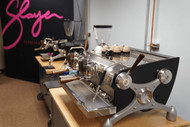
For a bar where the machine is a visible centerpiece — where the craft is the experience and low-volume precision work is the whole point — the Kees Van Der Westen Speedster ($16,999) has a higher extraction precision ceiling than anything else in the commercial market. Handmade in the Netherlands in small batches. Visions Espresso has semi-exclusive Pacific Northwest access — you can't walk into most dealers and order one.
For a bar that wants more extraction control than the Appia Life offers but at a lower price point than the Speedster, the Victoria Arduino E1 Prima ($6,990) adds volumetric dosing and T3 triple temperature management in a compact form that fits a specialty-forward single-barista bar.
Independent Neighborhood Café (150–250 drinks/day)
The operation: You have two to four staff members, including some who are newer to espresso. Your menu is latte-forward — 60–70% of drinks involve steamed milk. Volume is consistent but not brutal: a steady 150–250 drinks per day, with weekend peaks. What this profile demands: Consistency across a rotating staff, reliable steam capacity for a milk-drink-heavy menu, and a service network that can get you a part when you need it.The Nuova Simonelli Appia Life is where most cafés in this profile land. At $5,100 for the 1-group and $7,250 for the Compact 2-group, volumetric dosing means every barista pulls a consistent dose from day one. Simonelli's service network is one of the deepest in commercial espresso. Automatic backflush keeps daily cleaning straightforward. Rated for 150+ drinks per day on a single group.
For operations at the upper end of this volume range with more experienced staff, the La Marzocco Linea Classic S ($10,750) adds dual boiler precision and a service record that's defined the industry standard for decades. La Marzocco has been building espresso machines in Florence since 1927 — the Linea Classic's longevity at this volume tier is well documented.
When steam demand pushes past what the Appia Life Compact's heat exchanger handles comfortably — a milk-drink-heavy menu at 200+ drinks per shift — the Appia Life XT 2-group ($10,900) gives you the full Simonelli volumetric platform with a larger boiler designed for sustained steam output.
High-Volume Destination Café (300+ drinks/day)
The operation: You're running a serious espresso bar — 300 to 500+ drinks on peak days, two or three baristas on the machine simultaneously, heavy milk drink demand, and a service window that doesn't slow down. Throughput and sustained steam capacity are what matter. Temperature stability needs to hold under load. What this profile demands: Multi-boiler architecture or dedicated steam capacity, a 2-group minimum (3-group at 400+ drinks), and machines built for continuous operation across a full shift. The SCA's research on extraction yield identifies brew temperature stability as a primary variable — at this volume, a machine that can't hold temperature under steam load shows up in the cup.The Nuova Simonelli Aurelia Wave ($11,550) is the most widely deployed machine in this tier among specialty cafés. Soft infusion system, T3 temperature management, and sustained steam output make it the default choice for high-volume operations that still care about extraction quality.
For destination cafés where specialty quality and high throughput both matter — flagship locations, third-wave independents with a loyal following — the Victoria Arduino White Eagle ($16,100) and Eagle One Tempo ($18,600) hold their quality ceiling further into a busy service. Victoria Arduino has been building espresso machines since 1905 and the White Eagle's WAVY temperature management delivers thermal consistency typically associated with lower-volume precision machines.
The La Marzocco GB5 S is the other name in this tier — the bar standard for operations where barista skill is high and quality cannot drop at volume. Multi-boiler per group head, each running at an independent temperature, relevant when you're pulling different espresso recipes simultaneously.
Hotel, Restaurant, or Office Coffee Program
The operation: Espresso is part of a broader hospitality service. Staff turnover is real, training time is limited, and the machine needs to produce consistent results without a dedicated barista dialing in every morning. Volume can range widely, but the primary constraint is people, not throughput. What this profile demands: Maximum consistency with minimum training dependency. Volumetric dosing at minimum; super-automatic where staff turnover is the hard constraint.The Nuova Simonelli Appia Life with volumetric dosing ($5,100–$7,250 depending on group count) handles this profile when some barista skill is available. Programmed dose means a new staff member produces a consistent volume from day one, with automatic backflush reducing the maintenance knowledge required.
Where staff skill is genuinely not available — hotel buffet service, large office environments, high-throughput self-service environments — Eversys super-automatics are a different product built for this scenario. One-touch operation, automatic cleaning cycles, minimal training requirements. It's a separate machine category, worth evaluating on its own terms if consistent output with untrained staff is the actual constraint.
The Grinder Is Half the Equation
Every machine on this page extracts what the grinder produces. A high-throughput machine like the Aurelia Wave paired with an underpowered grinder wastes the machine's capability entirely. Grind consistency, particle distribution, and dose stability are grinder variables — the espresso machine works with what it receives.
For neighborhood cafés and boutique bars, the Mazzer Major V and Nuova Simonelli Mythos series are the natural pairings — flat-burr grinders that match the throughput of the Appia Life and Rocket Boxer. For high-volume operations, grinder selection is as consequential as machine selection. Browse the top-rated commercial espresso grinders or read the high-volume café grinder guide before finalizing your equipment list.
Frequently Asked Questions
What's the best espresso machine for a small coffee shop?
For a small coffee shop under 150 drinks per day, the Rocket Boxer 1-group ($5,230) fits skilled-barista operations, and the Nuova Simonelli Appia Life 1-group ($5,100) fits operations that need consistency across a growing team. Both are genuine commercial machines — not prosumer equipment — at prices accessible to an independent operator. The under-$10k comparison covers all five options at this price point with full trade-off analysis.
How much should a coffee shop spend on an espresso machine?
For most independent cafés, the $5,100–$11,000 range covers the realistic machine needs of operations from 50 to 300 drinks per day. The step above $10,000 buys sustained steam capacity, multi-boiler architecture, and scale — relevant when you're consistently above 300 drinks daily. Below that threshold, the machines in the $5,100–$10,900 range are not compromises; they're what most specialty cafés actually run.
Do I need a commercial espresso machine for a coffee shop?
Yes. Prosumer machines (La Marzocco Linea Mini, Rocket R58) are engineered with commercial components but not rated for sustained café volume. Running prosumer equipment at full service throughput accelerates wear, shortens service life significantly, and typically voids the warranty. Commercial machines are built for 6–12 hours of continuous operation daily — that's the engineering difference, not just the price.
How many group heads does a coffee shop need?
1-group works for owner-operated or boutique bars under 150 drinks per day. 2-group covers most independent neighborhood cafés in the 150–300 drink range, and lets two baristas pull simultaneously during peak service. 3-group becomes relevant above 400 drinks per day. Most independent cafés start with a 2-group and plan for a second machine before adding a third group.
Not sure which profile fits your operation? We carry every machine on this page and can match your volume, menu, and staff to the right one — straight answer, no sales pitch.
Talk to Our Equipment Specialists